
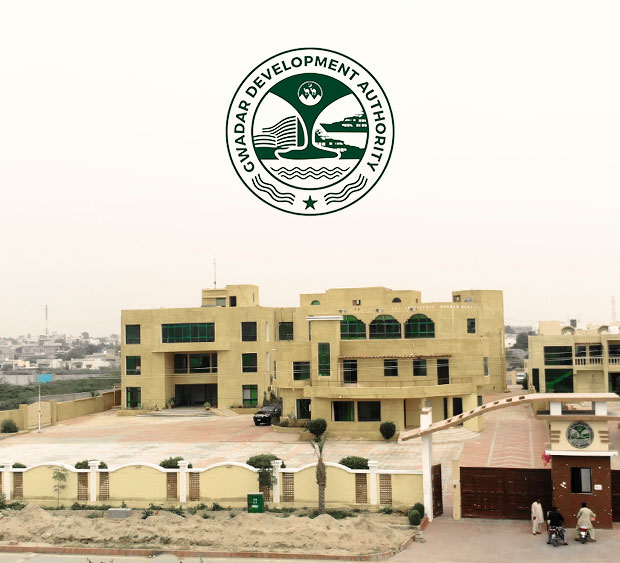
Gwadar Development Authority
The port project began in March 2002 with the expectation of significant growth for the town. To manage this growth, the Gwadar Master Plan was introduced, and the Gwadar Development Authority was established in October 2003 to implement the plan. Initially focused on land use, the Master Plan later included the development of the internal road network, land zoning, and vision for Gwadar’s future, leading to the adoption of the Gwadar Town Planning Regulations.
Gallery


Master Plans
The area along the East Bay Expressway enjoys good development conditions and spatial momentum. The existing urban area and the area along East Bay Expressway are, therefore, key development areas in the short term. Besides, as the city’s development needs huge funds in the short term industries are still in their initial stage, and policy support needs to be put in place gradually, the city will have more spending and less income even if financial support from the higher-level government is included. In order to acquired startup funds for the city’s short-term development, GDA plans to incorporate all government-owned land (mostly located in CBD) into short-term construction.35 Therefore, the urban development area planned for the short term is 118.0 sq. km, with an incremental population of about 160,000 and an increased employed population of 90,000 to 120,000.
As regards land supply, in the short term, Industrial Land and Warehouse Logistics Land are combined to a total of 2,172 ha. Business & Commercial Land totals 590 ha.
Residential Land totals 3,933 ha. Business & Residential Mixed Land totals 587 ha. As regards to industrial development, it is suggested to provide sufficient policy support to the Free Zone to facilitate the construction of the Northern Zone and speed up the construction of existing industrial parks such as GIEDA. Efforts should be made to improve supporting facilities for fishing industry and encourage the development of aquaculture and pelagic fishery. Efforts shall be made to enable the settlement of oil refinery projects in the Oil City in the east (It is not within the planning boundary but its urban service relies on Gwadar’s urban area).
As regards to large public service facilities and parks, emphasis will be placed on the improvement of existing facilities, including the extension of GDA Hospital to increase the number of beds to 300(the General Hospital and the rest of the hospitals at lower levels to be constructed according to actual need), construction of Pak-China Technical and Vocational Institute, and continued construction of the University of TURBAT and
the Sports Complex.
In terms of large-scale transport facilities, while maintaining the existing function of N10 as a transmit road, it is proposed to complete the construction of the East Bay Expressway (in the short term, other existing urban roads should maintain their existing functions while newly planned urban roads should be constructed according to actual needs). The new airport will be constructed as scheduled. The fishing port in the old city will be relocated to the typhoon shelter in West Bay. Based on the first-phase construction, the Gwadar Port will be extended (including supporting shipping lane and breakwater projects) to form a port coastline totaling 4,031m, with a land area of 2km2and a total designed handling capacity of 38.7 million tons per year.
As regards the smart city, MAN (metropolitan area network), and fiber broadband network, it will be constructed in the short term in order to increase the coverage of 4G network and improve its service capacity. A data center (equipment needed in the short term to be installed in the emergency command sub-center for safe city) and a disaster recovery data center will be constructed. A smart city operation center (co-established with the emergency command sub-center) will be constructed. A platform for data sharing and exchange to enable sharing of data from core departments and a public database and an urban operation and management gateway will be established. IoT sensing devices will be installed in several demonstration sites.
As regards to the safe city, emphasis will be placed on the construction of the urban emergency command sub-center, fences and checkpoints around the core area, fences around key facilities, security infrastructure, and network infrastructure. Video monitoring equipment will be installed in key areas in line with the strategy for smart city construction. Administrative systems will be introduced to exercise regulation on population and vehicles.
As regard to municipal facilities, priority projects for the short term will be launched as
follows:
(1) Water supply engineering. East Bay Desalination Plant will be constructed, with a handling capacity of 70,000 m³ per day. Another desalination plant in the Free Zone will also be constructed, with a handling capacity of 5,000 m³ per day.
(2) Reclaimed water engineering. One Reclaimed Water Plant (east bay) with a handling capacity of 15,000 m³ per day, Three Reclaimed Water Plants (west bay) with a handling capacity of 15,000 m³ per day, and Free Zone Reclaimed Water Plant with a handling capacity of 7,000 m³ per day will be constructed. After their completion, the total supply of reclaimed water will add up to 32,000 m³ per day.
(3) Drainage engineering. It is forecasted that sewage volume will amount to 51,000 m³ per day, with a centralized collection rate of 0.7. One Wastewater Treatment Plant (east bay) with a treatment capacity of 20,000 m³ per day, Three Wastewater Treatment Plant (east bay) with a treatment capacity of 5,000 m³ per day, Three
(4) Wastewater Treatment Plant (west bay) with a treatment capacity of 20,000 m³ per
day, and Free Zone Sewage Plant with a treatment capacity of 10,000 m³ per day will be constructed.
(5) Electric power engineering. 2*150MW coal-fired generating units will be constructed in East Bay. Distributed generation equipment will be installed in the startup area of the Free Zone. PV power stations will be built to supply electricity to desalination plants. Two 220kv transformer substations and ten 132kv transformer substations will be constructed, in which one was upgraded from existing 66kV transformer substations.
(6) Telecommunication engineering. A CATV building will be constructed; A IDC building will be constructed and placed in the safe city emergency command sub-center
in the short term.
(7) Gas engineering. An LNG terminal will be built at Gwadar Port to provide gas for urban residents via MG mid-pressure pipes.
(8) Sanitary engineering. A waste landfill and 22 waste transfer stations will be constructed.
The urban development area planned for the medium term covers an area of 65.0 sq. km, with an incremental population of 300,000 and an increased employed population of 210,000 to 240,000. It is planned to extend northeastward and northwestward based on the built-up area.
As regards to land supply, in the medium term, Industrial Land and Warehouse Logistics Land are combined to total 2,540 ha. Business & Commercial Land totals 252 ha. Residential Land totals 1,427 ha. Business & Residential Mixed Land totals 233 ha. As regards to industrial development, based on industrial foundations laid in the short term, industrial land will be extended along traffic arteries including East Bay Expressway so as to promote large-scale industrial development.
As regards to large public service facilities and parks, emphasis will be placed on the construction of an industrial service center, vocational training institutes, a 500-bed teaching hospital, an industrial park stadium, and an industrial park so as to provide well-established service facilities for production activities and daily life. Development of the eastern portion of CBD will be facilitated and City Public Library will be constructed.
As regards to large transport infrastructure, Northern Bypass will be constructed and if the conditions permit, East Bay Expressway will be extended to the new airport and intercity trunks added to improve intercity transportation conditions. Efforts will be made to kick off the construction of the railway between Jacobabad (or Karachi) and Gwadar and the construction of the railway linking northern mining areas of Balochistan (the Gwadar-Panjgur-Mashkhel-Nokundi) and its railway stations. The comprehensive port area will continue to be extended, with a planned additional coastline totaling 7,630m, an additional land area of 1.86km2 and an additional handling capacity of 65.2 million tons per year.
As regards to the smart city, coverage of fiber broadband network and mobile broadband network will be expanded and area accessible by video monitoring and other sensing devices will be enlarged. An independent main data center will be planned and constructed in the administrative center. The first-phase data equipment installed in the emergency command sub-center for the safe city will be moved to the main data center. The smart city operation and management center will be relocated to the emergency command center. The number of departments with access to the data sharing and exchange platform will be increased. The public database and the urban operation and management gateway will be improved.
As regards to the safe city, fences around the planning area, the urban emergency command center and the security training base will be constructed and the urban video monitoring and alarm network system will be improved. The grid administration system for the safe city will be established. Fences around the core area will be removed as appropriate. As regard to municipal facilities, priority projects for the medium term will be launched as follows:
- Water supply engineering. It is forecasted that water consumption in the medium term will total 180,000 m³ per day. East Bay Desalination Plant will be extended to achieve a handling capacity of 180,000 m³ per day.
- Reclaimed water engineering. It is forecasted that water supply in the medium term will reach 99,000 m³ per day. 1#Reclaimed Water Plant (east bay) will be extended to achieve a handling capacity of 25,000 m³ per day. 3#Reclaimed Water Plant (east bay) with a handling capacity of 25,000 m³ per day will be constructed. 3#Reclaimed Water
Plant (west bay) will be extended to achieve a handling capacity of 35,000 m³ per day. Free Zone Reclaimed Water Plant will be extended to achieve a handling capacity of 15,000 m3.
- Drainage engineering. It is forecast that sewage volume will amount to 122,000 m³ per day in the medium term, with a centralized collection rate of 0.9. 1#Wastewater Treatment Plant (east bay) will be extended to achieve a treatment capacity of 30,000 m³ per day. 3#Wastewater Treatment Plant (east bay) will be extended to achieve a treatment capacity of 30,000 m³ per day, 3#Wastewater Treatment Plant (west bay) will be extended to achieve a treatment capacity of 45,000 m³ per day. Free Zone Sewage Plant will be extended to achieve a treatment capacity of 20,000 m³ per day
- Electric power engineering. 3*200MW gas-steam combined cycle units will be constructed in the eastern area. Two 220kv transformer substations and seven 132kv transformer substations will be constructed.
- Telecommunication engineering. A communication building will be constructed; The IDC building that located on the safe city emergency command subcenter will be moved to the administrative center.
- Gas engineering. A LNG terminal and gate station and a gas pressure regulating station will be built at East Bay to connect with the gas-fired power plant via sub-high pressure pipelines.
- Sanitary engineering. A waste incineration plant and 27 waste transfer stations will be constructed.
The long-term urban development plan for an area covering 154.7 square kilometers is set to accommodate an incremental population of 1,400,000 and an additional employed population of 700,000 to 840,000. The focus of urban expansion will be West Bay, utilizing its natural and landscape resources to establish itself as a key area projecting the urban image.
In terms of land supply, the plan involves initiating the development of other urban areas in the long term.
Industrial development aims to extend the industrial area northward to support the upgrading of the industrial structure towards new and hi-tech industries, as well as the high-end service industry, enhancing the industrial competitiveness of Gwadar.
Key large public service facilities and parks include the Administrative Service Center, International Exhibition Center, Cultural and Art Exchange Center, Planning Exhibition Hall, History Museum, Youth Cultural Activity Center, Science and Technology Exchange Center, University City, 500-bed Teaching Hospital, an office area for foreign consulates and international organizations or institutions, Gwadar Park, and Grand Mosque.
Transport infrastructure improvements involve enhancing the urban road network and transforming the comprehensive port area into a commercial port, handling general and bulk cargo, with additional coastlines, land area, and handling capacity.
The smart city initiative includes expanding fiber and mobile broadband networks, increasing data center capacity, planning a remote data center for disaster recovery, enlarging areas accessible by video monitoring and sensing devices, and connecting the data sharing and exchange platform within the smart city operation and management center with all departments. A platform for big data access, mining, and analysis will also be constructed.
For a safe city, plans involve establishing a weapons-free zone with a comprehensive security system, a well-established fence network, and improved systems for security-related laws and police administration.
Priority municipal facilities projects for the long term include water supply engineering, reclaimed water engineering, drainage engineering, electric power engineering, telecommunication engineering, gas engineering, and sanitary engineering. These projects aim to address the forecasted water consumption, sewage volume, and other essential infrastructure needs.